 |
| Cartoon by H. T. Webster, 1948 New York Herald Tribune |
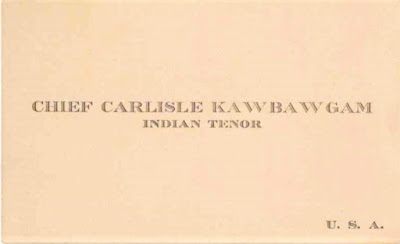 |
| Business card of Carlisle Kawbawgam |
In 1912 the Red Caruso
burst on the scene, drawing admiration and sneers from both sides of the
Atlantic.
Six feet tall, the papers reported, and a magnificent tenor, twenty-six year old Carlisle Kawbawgam told the world that he was the son of the last chief of the Chippewa tribe of Michigan’s Upper Peninsula.
“The copper-colored Indian is a magnificent specimen of young manhood,” declared the New York Dramatic Mirror. Audiences and critics predicted that Kawbawgam would soar. He had a brilliant future in opera, they said.
At least one editor spewed venom:
The spectacle of Poor Lo singing high “C” should be sufficient
to give one pause. Incidentally, if there is any foundation in fact for the
story, we would advise “Jim” Thorpe to get out of his present popularity all
that he can.
“Poor Lo,” a derogatory name for Native Americans, became popular in the U.S. during the nineteenth century. It derives from “An Essay on Man” by the English poet Alexander Pope, who wrote:
Lo, the poor Indian! whose untutored mind
Sees God in clouds, or hears Him in the wind . . .
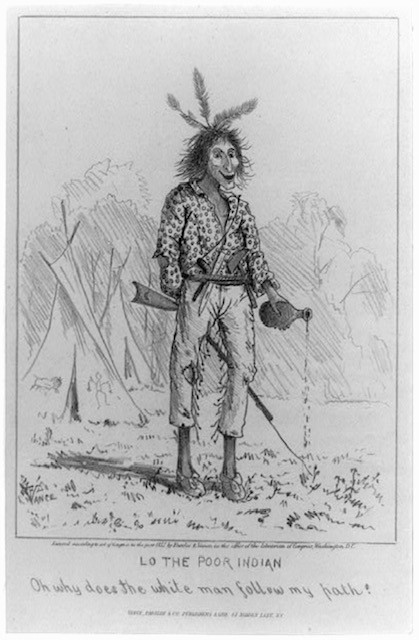 |
| "LO THE POOR INDIAN" (1875) (Library of Congress) |
During adolescence, Kawbawgam said, he left the Chippewa village and traveled to Pennsylvania to enroll at the Carlisle Indian Industrial School. If he actually attended Carlisle, he may have entered willingly or forcibly. The government-run boarding school had one goal: total assimilation and acculturation in white society. Students were brutally subjected to reprogramming.
Later, when he became a singer, Kawbawgam announced that he chose the name “Carlisle” as a tribute to his alma mater. Immediately, numerous journalists and the Commissioner of Indian Affairs wrote to Moses Friedman, superintendent of the school, inquiring about the former student. Friedman replied that he had no record of this famous alumnus.
 |
| Carlisle School Superintendent Moses Friedman informs the U.S. Commissioner of Indian Affairs that Carlisle Kawbawgam never attended the boarding school. |
Now the young man, it would be reported, went off to the Yale School of Medicine—except Yale has no record of his enrollment. The
first Native American graduate of Yale, Henry Roe Cloud, received a B.A. in
1910.
Kawbawgam may have attended Yale under a different name. But in the age of Jim Crow, it is unlikely that a Native American—even "unblanketed and unmoccasined," as one observer noted—could have passed.
Onward to Washington, D.C., where Theodore Roosevelt inhabited the presidency and smart society had sprung back to life after years of late Victorian stuffiness.
There, Kawbawgam practiced medicine and sang at private events to earn extra money. During a performance for a Latin American legation, he met and fell in love with Alma Lopez, a Chilean woman of Aztec descent. They married and sailed to Europe. Kawbawgam planned to tour, then settle in Berlin to study with an American expat, Frank King Clark, a well-known voice and elocution teacher.
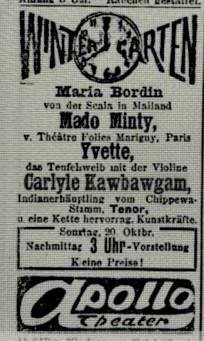 |
| Advertisement for one of Kawbawgam's performances in Berlin |
In December 1912, rave
reviews started flying across the ocean.
GERMANS
DISCOVER AN INDIAN CARUSO
Graduate
of Carlisle School
Hailed
in Berlin and Vienna
As
Coming Opera Star
TO
GIVE UP VAUDEVILLE
But Kawbawgam did not give
up vaudeville. He continued to perform in music halls, never opera houses. Perhaps
he studied with Clark until war broke out in 1914; then he and his wife moved
to London. There he appeared regularly, always with second billing, at the Trocadero
Restaurant and the Alhambra.
Often appearing alongside him were an Australian swimmer and
diver, Annette Kellermann; a Parisian torch singer, Mlle. Damia; and a Japanese family
of ventriloquists and pantomimists, the Hammamuras.
Of Kawbawgam, English critics “declared unreservedly that an undeniably wonderful talent lies hidden in his bronze throat,” according to a report in the New York Times.
He lately inherited the chieftaincy of the Chippewa through
the death of his father, is erect as a sycamore and Indian in every line of his
gaunt frame and physiognomy. He is really a “medicine man” by profession. . .
While Kawbawgam performed as a singer in the London variety shows, he probably also had parts in minstrel-type skits like “The Indian Mail Carrier” and “Queen of the Redskins.”
He and Alma stayed in England through World War I. Carlisle Jr. was born in 1916 and little Alma came along in 1919. A few years later, the family sailed to New York on the Red Star Line. Whether they stayed in the U.S. or returned to England is a mystery.
Carlisle Kawbawgam is a mystery, too. A Native American of ambiguous ancestry, he may have been a poser (as the British say) or a faker (as the Americans say). Perhaps he fabricated his education at Carlisle and Yale. Perhaps he practiced medicine under false pretenses. We don’t know.
One thing is certain: he dreamed of being an opera star.
Soon after Kawbawgam’s name began to appear in newspapers, a chronicler of Ohio who authored interminable books about the glory days of the frontier, wrote:*
Certainly the Indians did not indulge in any kind of music to
the extent that did other races. They had few songs or refrains, and no musical
instruments worthy of the name. In fact, they were a silent, sullen people, and
did not even indulge in laughter to the extent that other people have. So if we
are to have an Indian singer who is to startle the world with his music, it
only shows what mighty transformation has been wrought in the Indian since he
first met the white man.
*Abraham J. Baughman, Past and Present of Wyandot County, Ohio (1913).
 |
| The chair pictured in 1891. |
The Turkey-work chair sat in the parlor of a house that overlooked the Connecticut River. In the winter when the river froze, the boy who grew up in the house with the chair liked to skate back and forth under the bridges.
His name was Henry. He knew by heart the cotton mills and iron foundries that hummed and clanged along the riverbank.
After the Civil War, the town of West Springfield, Mass. would become even more industrialized, but when Henry bustled through the front door of his home, red-cheeked and dangling his skates, he returned to an earlier century.
 |
West Springfield, Mass., late nineteenth century |
Perhaps he cast an eye
toward the chair in the corner. His father and mother were protective of it, so
they kept it out of the way.
The chair once belonged to Roger Williams, founder of the Rhode Island Colony and champion of religious freedom. Built around 1670, it had been passed down through several generations who didn’t have to apply for membership in the Daughters or Sons of the American Revolution. They were originals.
The boy’s father, also named Henry, was a dour bookbinder born in Hartford in 1831. He lived modestly with his second wife, Henrietta, and their son. The cupboards were filled with creamware and lusterware and the floors covered with hand-hooked rugs. Nobody thought of these things as antiques; they were just old family possessions with sentimental value.
In his youth, the bookbinder caused his widowed mother plenty of headaches. He periodically disappeared and reappeared to announce he was heading to Pike’s Peak to strike gold or to New York City to try his hand at a new profession which he hadn’t yet determined.
His mother believed that the devil’s workshop lay immediately beyond the borders of New England, and she was pleased when her son met and married Therese in 1853 and settled in West Springfield, where he started in the bookmaking field as an edge-gilder.
 |
| The American Bookmaker was one of several trade journals devoted to bookmaking during the nineteenth century. |
Turkey-work chairs got
their name from the upholstery used on the back and seat, a wool fabric loomed
in England to resemble Turkish carpets.
The Roger Williams chair, carved from maple and oak, was stuffed with marsh-grass and covered with sackcloth. The floral upholstery had been attached with wrought-iron tacks.
***
Eventually, the boy who liked to skate on the Connecticut River grew up and married, and he and his wife moved next door to his parents in 1890. (The arrangement did not please the young man’s elegant new wife, but she got back at him by fleeing to her family home in Syracuse, N.Y. as often as possible.)
The century turned and the unthinkable occurred—a world war. A few years after the 1918 Armistice, Henrietta died.
One day Henry received a letter from the president of the Rhode Island Historical Society, asking if he would consider donating Roger Williams’ Turkey-work chair to its collection.
Henry agreed that the gift made sense. He did not realize that the letter was a ploy. The man behind the request, a sneaky antiques dealer named Charles Woolsey Lyon, absconded with the chair to his shop in Manhattan and sold it in 1923.
 |
| This advertisement for Charles Woolsey Lyon's shop appeared in Arts and Decoration in 1920. |
Henry, who died in 1925 at
the age of ninety-four, probably did not know what became of the chair. In
hindsight, the theft may have been a mixed blessing because the purchaser, Mrs.
J. Insley Blair, ultimately bequeathed the chair to the Metropolitan Museum of
Art, where it lives today.
Otherwise, who knows? The Turkey-work chair might have languished in West Springfield, lost in a fire or discarded by a descendant who did not understand its worth.
Natalie Blair, married to an heir to one of America’s first million-dollar fortunes, developed a passion for Early American antiques during the 1920s.
The Blairs lived in a
65-room mansion in Tuxedo Park, N.Y., an exclusive village in the lower Hudson
River Valley, designed by the renowned architectural firm Carrere and Hastings.
Natalie filled the large attic rooms with furniture and art organized by
historical period.
 |
| The chair as it appears in American Furniture in the Metropolitan Museum of Art by Frances Gruber Safford (2007). |
Thirty short blocks and one long one from the antique shop of Charles Woolsey Lyon, a man whose sterling reputation hid at least one incident of deceit.
And far from the house on the Connecticut River where the boy and his parents inhabited four centuries.
https://www.throughthehourglass.com/2021/12/mrs-blair-turkey-work-chair.html?m=1

If you were searching for something to read in colonial America, you might have picked up Gulliver’s Travels, Poor Richard’s Almanack or, of course, the Bible.
But soon enough, the rising book trade along the East Coast would have increased your options exponentially. By the mid-eighteenth century, shops flourished in Boston, Philadelphia, and New York, with titles in history, theology, science, and travel in greatest demand.
The American bookseller had a notorious persona: gruff, tough and fiercely competitive. Many were rude without being malevolent, but occasionally one might sabotage another with a false accusation of fraud—passing along reproductions of ancient texts—or avoiding customs taxes with fake receipts.
By the 1890s, these sellers were a dying breed. Among the few remaining bookmen of the nineteenth century who retained his scowl and his integrity until the end, Charles Lowell Woodward closed the door upon this life on September 17, 1903.
His passion for books went back to his childhood in rural Maine, inculcated by his father Caleb, an abolitionist and jack-of-all-trades, whom he revered. But Charles didn’t want to hang around the farm. He had the urge for going, as Tom Rush sang.
At the age of 20, he took off for California, delirious with gold fever. He sailed around Cape Horn and found work at the Poverty Hill Mines near the Yuba River, about 100 miles northwest of Sacramento. While building a well, he fell into it and broke his ankle. This put an end to his mining career and he headed back east.
Ankle problems prevented Charles from serving in the Civil War, so he joined the New England Society, a charitable organization that was old even then, and helped care for hospitalized soldiers and their families.
When the war was over, Charles answered the call of the Pennsylvania oil fields but a flood left him homeless with two trunks of possessions. One was packed with books.
He landed in New York City at the age of 32.
 |
| Nassau Street bookshops, 1895* (E.D. French) |
There, while working as an agent for
Bradstreet’s, Charles began to haunt the old bookshops that were clustered
downtown along the narrow streets. In the morning, up went the striped awnings. The
sellers hauled wooden bins full of prints and maps onto the sidewalks and
rearranged their window displays.
Some of the stores were windowless and light entered only through the front door, if it happened to be open. Dingy and dusty, the air inside nearly as congested as the sky above the industrial waterfront, the shops nonetheless attracted plenty of luminaries.
Perusing the shelves, you might spy former President Ulysses S. Grant, the actor Edwin Booth or the Reverend Henry Ward Beecher, not to mention Tammany pols, capitalists, and Bohemians. Swiftly obsessed, Charles joined the ranks of the collectors. Americana and Mormonism were his particular interests.
In 1875, Charles finally
possessed enough books and savings to open his own bookshop, located in a dark
room at the rear of the second floor of 78 Nassau Street. He kept the store tidy
and broom-swept and took the unusual step of shelving the most valuable books
with the titles facing inward. Thus, he maintained absolute control over who
handled them.
 |
| Charles Lowell Woodward took pride in the tongue-in-cheek advertisements that he placed in Publishers Weekly and trade journals. |
Charles disdained presumptuous
customers. His “rough and often repelling exterior fairly bristled with hatred
of humbug, cant, and pretense,” wrote one of his colleagues.
He found genealogical research especially contemptible. Customers in search of family trees were handed the “donkey catalogue,” a list of books related to ancestral lineage, its cover decorated with a picture of a donkey.
But Charles had a special fondness for certain clients, including the librarian and historian George H. Moore, once dubbed “Clio’s high-priest.” (In Greek mythology, Clio was the muse of history.) Moore worked for many years at the New-York Historical Society and the Lenox Library, a precursor to the NYPL. He had the habit of dropping by 78 Nassau Street during the early evening. After Charles locked up around 9 o’clock, the two men would sit on a bench in City Hall Park and talk far into the night.
Oh, to hide in the shrubbery near the fountain and eavesdrop on their discussions!
 |
| City Hall at night, 1900 |
In 1902, Charles was hit by a wagon
that came barreling down Nassau Street, and his health began to decline.
One of his daughters—perhaps Polly or Daisy—started to help around the shop.
But it was clear that the business could not continue after his death and he
made the decision to sell his stock and close the store.
After World War I, new construction invaded Nassau and the other old streets. Park Avenue South, eight blocks between Union Square and Astor Place, became Manhattan’s “Book Row.” Further on, that neighborhood would have its own obituary.
 |
| Advertisement, New York Times, November 1903 |
*from Booksellers of Old New York and other papers by William Loring Andrews (1895).
https://www.throughthehourglass.com/2021/11/charles-lowell-woodward-book-peddler.html?m=1
 |
| John P. Marquand by Gardner Cox, 1955 National Portrait Gallery, Smithsonian Institution Gift of Phyllis B. Cox |
Except I’d say it like this: “Rally my dear, ra-a-a-ally!”
The reply never failed to annoy them. Right now, relatively late in the game, I would like to apologize because it is, indeed, very annoying.
It would have been better, perhaps, to know where “ra-a-a-ally” came from, but I could not recall. It was imprinted on my brain, something I’d read many years earlier, which stuck.
But just a few weeks ago, I discovered the source while scanning the shelves for a comfortable old shoe sort of book.
During the sixties and seventies, my parents owned a modest beach house on Gardiner’s Bay in East Hampton. At the time, East Hampton was relatively modest, too. There was no Elie Tahari, J. Crew and Ralph Lauren, but there was an A&P, a grocery store with a donut machine, two pharmacies, a nineteenth-century windmill, and a movie theater with a single screen.
Best of all was the bookstore run by the Ladies Village Improvement Society. Used books, of course. And a wonderful range—bestsellers, Book-of-the-Month Club, and lots of novels that were popular during the forties and after the war.
As the historian Joan Shelley Rubin wrote:
On rainy summer afternoons, the inhabitants of the cottages
for rent along the New England coast or the lakes of the Midwest sometimes grow
restless. Tired of Monopoly and finished with the stack of current fiction
imported from home, they fasten their
attention on the well-worn books that, like the mismatched china and frayed rag
rugs, furnish the house. Among the faded volumes on the shelves, certain titles
turn up with the faithfulness of an old friend . . .
At the LVIS bookstore in
East Hampton, one might stumble over the oeuvre of a single author. Such
was the case for me and John P. Marquand (1893-1960), who first gained renown for
his Mr. Moto series about a Japanese secret agent. Several of these books
became films.
 |
| Poster for Think Fast, Mr. Moto 1937 |
Marquand proceeded through the 1940s and ’50s, producing well-plotted books about affluent men and women, some with pedigrees, who were navigating cultural pretensions old and new.
In So Little Time (1943), Jeffrey Wilson, a script doctor, and his wife Madge are driving to a weekend party at the home of Beckie—Madge’s oldest friend—and her husband, Fred.
Madge said that Fred and Beckie had such luck, and their old farm in Connecticut was just another example of it. It had simply been an old ramshackle tumbledown place occupied by an Italian family named Leveroni, although the house was one of the dearest old salt-boxes that Beckie had ever seen, whatever a salt-box might be, and it dated back easily to the Revolutionary War. Beckie was the one who saw its possibilities.

The critics wrote that Marquand was a superb satirist, delivering send-ups of bluebloods like Beckie and Fred who sashayed between New York and Boston, Park Avenue and the Berkshires.
I think the most interesting characteristic of Marquand’s protagonists is how they shift from present to past, and how their memories keep yanking them back to the small towns from whence they came.
Jeffrey Wilson, for example, realizes that one of the guests at Fred and Beckie’s party is an Edward Murrow-like journalist who covers the war from the frontline.
“Hello, Walter,” Jeffrey said.
“Why, I didn’t know you knew Mr. Newcombe,” Beckie said.
Yes, Jeffrey does know Walter Newcombe. They both grew up in Bragg, Massachusetts, and got started working for a curmudgeonly editor at a Boston newspaper; Walter just a squirt in the telegraph room.
Throughout the weekend, Beckie can’t get over the coincidence, which makes her feel important. She hopes Jeffrey will draw Walter out.
During dinner, Walter’s irrepressible wife is seated beside Jeffrey. She says to him:
“It isn’t the soup,” Jeffrey said. “You ought not to kill a duck and do anything like that to it.” But Mrs. Newcombe was not interested.
“Not rahally,” she said, “not rahally, dear old chap.”
So there you are.
At the end of So Little
Time, after Jeffrey’s son enlists and announces his engagement to a young woman from a fine family, Jeffrey’s
mind flees to the past.
For some reason he was thinking about Madge as she had looked
when he had first seen her there by the tennis court at her father’s house,
years and years ago when they had been so young. Something had happened to her
dress, he remembered. She had wanted a pin for her dress. She had always wanted
something from him. He had thought at one time that he had nothing left to give
her, but now he knew that there was always something he could give, without
desiring to, perhaps, but always something. He could always give her something,
and she was the only one.
But Madge is superficial, I remember protesting to myself—too young to grasp the big picture . . .
 |
| The Late George Apley, 1937 |
Sources: So Little Time by John P. Marquand (1943); The Making of Middlebrow Culture by Joan Shelley Rubin (1992).
https://www.throughthehourglass.com/2021/10/growing-up-with-john-p-marquand.html?m=1
 |
| First pages of Mary Ann Horneman's pamphlet, The First Ladies of the White House (in miniature) |
I can’t wait to get back to 1941 so that I can see Mary Ann Horneman at the annual convention of the South Dakota Federation of Women’s Clubs.
She’s been invited there to give a presentation about America’s First Ladies: sing old-time songs, tell stories, show off her collection of First Ladies dolls.
Each doll—Adams, Coolidge and the rest of the gang—is dressed in a copy of the gown worn by her corresponding mannequin in the First Ladies Hall at the Smithsonian Institution.
Mary Ann made the dolls and their costumes, painted their portrait faces, and stitched their satin skirts and lace bodices.
She launched her career as a lecturer and entertainer after publishing a small book, 5”x7”, that contains photographs of her dolls and a few paragraphs about each First Lady. Since then, she has been traveling around the Dakotas, Nebraska, Iowa, and Kansas, visiting every women’s group that needs a speaker.
It’s real tea party stuff. Crowned with a headdress, swishing her own satin skirt, Mary Ann presents the First Ladies as the finest examples of American womanhood, each a study in courage and beauty. The audience clucks and nods.
Before Mary Ann introduces her dolls at the big meeting, Gertrude Null, president of the Federation, will speak about “The Importance of Being a Woman.” Miss Null is a music teacher who grew up in Huron, S.D. not too far from the Minnesota border. Incorporated in 1883, Huron rose on the banks of the James River, blessed by the Chicago and Northwestern Railway.
Huron is not unlike the city of Beloit in north central Kansas, where Mary Ann was born and would spend most of her life. Perched over the Solomon River, Beloit boomed after the Civil War thanks to the Missouri Pacific and Union Pacific Railroads, which passed through town carrying grain and passengers.
Gertrude and Mary Ann were born, respectively, in 1889 and 1886. They were the daughters of wealthy men. Mr. Null practiced law and Mr. Horneman owned a furniture store that bulged with overstock.
Local and regional women’s organizations, like the South Dakota Federation, began to proliferate after the Civil War. Most of them sponsored pleasant social gatherings with performances and lectures by members. During the 1890s, however, the women’s club movement really took off. It grabbed thousands of white women like Mary Ann and Gertrude whose hometowns were scattered across the Great Plains.
Having imbibed the Victorian niceties of their mothers, Mary Ann and her peers tended toward the tinkly side of things. Yet they were very much a different generation, one that reached tentatively for new ideas. They wanted to learn about social issues like child welfare, took sides on Prohibition and women’s suffrage, and believed in reform, albeit incrementally. They agreed on “The Importance of Being a Woman,” but few met the definition of first wave feminist.
 |
| 1916: Black professional women's club (New York Public Library) |
That fight was still going on, right in the middle of the New Deal in March 1936, when 18-year old Hilda Jones, a Black student at Girls Commercial High School in Brooklyn, won a contest to design a print for a dress to be worn by Eleanor Roosevelt.

The story ran on the first page of The Voice of Colorado, a weekly with a largely Black readership, which had so little use for the Roosevelts that it endorsed Alf Landon for president that year. The bitter fight to organize the Southern Tenant Farmers Union in Arkansas, and the W.P.A.’s blind eye toward its own inequitable distribution of resources, dwarfed the story with the headline “Negro’s Design Bought by Mrs. Roosevelt.”
 |
| Girls who entered the competition show off their designs. Hilda is standing, second from right. |
Eleanor Roosevelt wore Hilda’s green and purple leaves, now imprinted on a chiffon dress, to a White House luncheon. Meanwhile, the young woman fervently hoped to become a commercial fabric designer.
By the time that Mary Ann Horneman started toting around her First Ladies show, Hilda had a factory job in one of the many manufacturing plants that once flourished in New York City. She never became a designer. After 1940 she disappears from record.
Hilda's connection to Mary Ann and Gertrude is a barely visible thread, but it exists.
“The buried talent is the sunken rock on which most lives strike and founder.”—Frederick William Faber (1814-1863), British theologian and hymnist
https://www.throughthehourglass.com/2021/09/hilda-jones.html?m=1
Postcard of Angel Island, 1915 Hung Yu-Feng arrived at Angel Island, in San Francisco Bay, on a foggy September day in 1919. His unlikely ...


