Showing posts with label Russian Revolution. Show all posts

Wednesday, March 11, 2026

How I Got to Harry


The little boy levels a serious gaze at the photographer peering through a Graflex camera. Ery Kehaya, Jr. has just tugged off a veil that covered The Discus Thrower, a bronze statue by a Greek sculptor who won first prize in an art contest held in conjunction with the 1924 Paris Olympics.

Now Ery’s father, a Turkish-born businessman married to a Southern belle, will present the statue to the City of New York. Grace stands beside him on the dais, watchful but smiling.

And look over there at the man with the wispy gray beard, 84th Street receding over his shoulder. Dressed in an overcoat on a warm spring day, he seems to have emerged from the eighteenth century. Is he Rip Van Winkle?

Impossible—this is Central Park, May 1926.    

The Kehaya family liked Park Avenue apartments and inhabited quite a few during the decades when Ery, Sr. ran the Standard Commercial Tobacco Company. Born in 1885, he grew up near Samsun, Turkey, along the southern coast of the Black Sea, a region known for a particular type of tobacco: aromatic and nutty with small leaves. 


Steered by his family toward religion and philosophy, Kehaya decided to go into the tobacco business instead. He immigrated to the U.S. in 1910 and founded his company two years later with $5,000. By 1928 the company had become a public corporation worth $12 million.

Kehaya influenced the tobacco trade in two important ways. He popularized Kentucky, Virginia, and Carolinas tobacco among Europe monopolies, and he introduced Asian and European tobaccos to American cigarette manufacturers.

It was all about the blend.


Ery Kehaya, 1926


Kehaya’s 1964 obituary did not mention the $4 million stock swindle that he and three of his officers pulled off in 1937. At trial, they pleaded guilty to violating Federal mail fraud, securities and exchange, and conspiracy statutes. The fines totaled $8,400; no sentences were imposed.

The company reorganized and flourishes today. The two-year old boy who disrobed the statue grew up and joined the company in 1945. He started by unloading tobacco on the New York docks and retired as chairman.


***


Among the four perpetrators, Harry D. Meyer was a vice president and director of Standard Commercial. The newspapers reported that he lived in Bronxville, an affluent village outside the city.

Like Ery Kehaya, Harry was born in 1885. His parents, Henry and Henrietta, were Alsatians who arrived in New York City during the 1880s, peak years of German immigration.

Living in Weehawken, N.J., the Meyer family grew quickly with seven children across 14 years. Henry owned a restaurant for some time. His sons went to work at young ages: Arthur and Herman became machinists in a factory and Harry, Edward, and Louis were office clerks.

Daughter Flora took off early; married and moved to Spokane. The youngest, Alfred, graduated from Cornell and became a veterinarian.

Now here came Harry, evidently ambitious. At the American Express Company, he started as a file clerk and was assistant to the general manager of the New York office when Standard Commercial hired him.  

American Express building,
Manhattan, 1910
Originally, American Express was a transport company. Until shifting to travel services during World War I, it specialized in freight forwarding. Freight forwarding encompasses all logistics and documentation involved in shipping a product (like tobacco) internationally.

Of course, the import and export of tobacco lay at the center of Keyaha’s business, and hiring Harry would have brought expertise in shipping. Unsurprisingly, Ery Kehaya came to depend on his new employee.

Within a few years, he entrusted Harry with an intriguing mission at a critical time in Western history.  

On February 21, 1917, Standard Commercial asked the U.S. Secretary of State, Robert Lansing, for permission to send Harry Meyer overseas.

The plan was for Harry to visit Russia, where he would purchase and arrange the shipment of tobacco to the U.S. Next up: Japan, Sweden, Norway, Canada, and England. The trip would last about six months.

Off went Harry on the Empress of Asia, departing Vancouver on March 15 and arriving in Petrograd (St. Petersburg) on April 22, 1917.

This was 16 days after President Woodrow Wilson asked Congress to declare war on Germany and six days after Vladimir Lenin, after years of self-exile in Europe, returned to Russia.

Petrograd, 1917
During Harry’s weeks in Russia, the country was in turmoil. Following the February Revolution, just months earlier, the Bolsheviks had forced the Tsar to abdicate.

With the Tsar dispatched, a Provisional Government, democratic in spirit, shared power with the Soviet (Bolsheviks). But the new regime did not fulfill its promise to lift up the starving, beleaguered masses, and Russia continued to commit soldiers and money to the Allied Powers fighting Germany.

Subsequently, the Bolsheviks withdrew their support of the Provisional Government and consolidated power under Lenin and Leon Trotsky. This was two days after Harry’s arrival.

The Bolsheviks quickly nationalized tobacco production. One wonders what became of the shipments Harry arranged. 

***

In 1944, Ery found his friend dead in his room at the Hotel Fresno. The two men had traveled to California to explore the possibility of raising tobacco in nearby Clovis. This would have been an unlikely enterprise. Fresno was a center for manufacturing and distributing cigarettes during World War II, but the soil had already proven to be inhospitable to tobacco.

The coroner reported that Harry died of a heart attack while playing solitaire.     

Hotel Fresno in its interwar heyday


*The Discus Thrower stood in Central Park until 1936, when it was moved to Randall’s Island. After years of neglect and vandalism, it was restored and now stands in the shadow of Icahn Stadium.

 https://www.throughthehourglass.com/2026/03/how-i-got-to-harry.html?m=1


Wednesday, October 4, 2023

Joseph Mandelkern's Return to Russia


Tolstoy and Gorky, 1900

On July 4, 1905, the Polish-born impresario and real estate man Joseph Mandelkern landed on page two of the New York Times.

The 41-year old hotshot had arrived in Europe a few weeks earlier. He toured Warsaw, Lodz, and Bialystok. In the small town of Dzialoszyce with its majestic synagogue, Mandelkern visited his widowed mother, whom he had not seen since 1884 when he immigrated to America.


FOUND ANARCHY IN POLAND

JOSEPH MANDELKERN OF NEW YORK

TELLS OF HIS OBSERVATIONS


He saw a parade of 20,000 people carrying red flags. Revolutionaries in blue shirts. Everyone armed with pistols and knives. 

It is intriguing that Mandelkern chose the summer of 1905, a scant six months after the First Russian Revolution, to make a three-month trip into political and social chaos.

Days before Mandelkern arrived in St. Petersburg, the officers of the battleship Potemkin had been overcome by revolution-minded mutineers who were enraged by their treatment during the Russo-Japanese War.

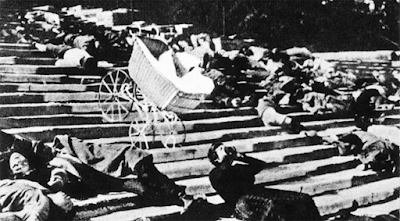
As famously portrayed in the 1925 film Battleship Potemkin, Cossacks murdered 1,000 men, women, and children who stood cheering the mutineers from the Richelieu Steps in Odessa while the ship was anchored offshore in the Black Sea. 


Famous scene from Battleship Potemkin, directed by 
Soviet film director Sergei Eisenstein 

It was a dangerous, bloody time but Mandelkern felt confident about navigating through the Russian Empire because he possessed a “release from allegiance” signed by a consul general named Count Ladyzhensky. Mandelkern had paid 800 rubles for the document.

A supply of Havana cigars also greased the wheels.

Crossing the border between Germany and Russia, Mandelkern became aware of a new word, “Uligani,” derived from the English word “hoodlum.”


It entered into every conversation he held, with friends or strangers, in his home city. He heard it uttered in terror at the bier of a murdered friend. When he looked for his dead father’s gravestone, the same word was whispered into his ear by the gravedigger as a warning. When he wanted to seek rest and recreation in a public park he heard it again on the lips of a gendarme.  

The Uligani preyed on everyone.     

Now here was Mandelkern, a Jew, making his way through Russia as if he were an old friend of Nicholas and Alexandra. He also visited two anti-Czarists, famous writers both—Leo Tolstoy and Maxim Gorky.

 Mandelkern boarded a train in Helsinki to reach Gorky, a 37-year old Socialist Realist author and Bolshevik sympathizer who spent his summers in a villa in Kokkola, Finland. After lunch, two messengers brought news of the Potemkin.

 “What have we to be afraid of?” Gorky mused aloud. “The time for secrecy is past. The change must come soon. Everybody knows it.”

Then Mandelkern went off to Yasnaya Polyana, Tolstoy’s country estate a few hours by train from Moscow. After lunch, Mandelkern learned that the Okhrana—the Czar’s secret police—regularly harassed Tolstoy. Meanwhile, the Bolsheviks demanded that he relinquish his property to divide among peasants. 

Returning to the U.S. in August, Mandelkern met with a Times reporter to share grim tales of corruption, deprivation, and violence.

Nonetheless, Mandelkern told the reporter, he detected courage among the Russians, a willingness to speak out against the Czar’s tyranny and the waste of the Russo-Japanese War.

***

By the time of his 1905 visit, Mandelkern had established himself as a stealthy theater agent who nabbed gifted performers. His fluency in English, Russian, and Polish enabled him to execute contracts before anyone else in the room knew the details.  

Always in motion, Mandelkern traveled through the Midwest and to Europe. His wife Pauline and their five children—at least two of whom were already superb musicians—watched him come and go.

One senses he was aloof and finicky.

He certainly had no time for his family in 1906, when Maxim Gorky accepted an invitation to come to America. Mandelkern even hinted at the possibility of a visit with President Theodore Roosevelt.


On a sparkly April day, Gorky arrived at Hoboken on a German steamship. A crowd of 1,000 greeted him. At the end of the gangplank, a delegation of socialists stretched out its hands: Abraham Cahan, editor of The Forward; Morris Hillquit, a labor lawyer; Gaylord Wilshire, a California entrepreneur; Leroy Scott, a writer and settlement worker; and Joseph Mandelkern. 

Thus began Gorky’s high-flying adventure with Mandelkern at his elbow. Lunch at the St. Regis. A visit to Grant’s Tomb. Watching children feed the squirrels in Central Park. The circus at Madison Square Garden.

“In a Russian city almost every other man one meets is either a soldier or a policeman,” Gorky told Mandelkern. “I haven’t seen a single soldier all day, and only two policemen. Marvelous!”

That evening, he was driven down Fifth Avenue to “Club A,” a brownstone owned by a group of revolutionary-minded New Yorkers. Here would occur the highlight of Gorky’s visit: dinner with Mark Twain, William Dean Howells, and other American writers who supported the movement to overthrow the Czar. 

A few days later, however, Gorky was beset by scandal.

It turned out that the writer had left his wife Katharine and two sons back in Russia. The woman who accompanied him to the U.S. was actress Maria Feodorovna Andreyeva, his mistress of several years.

Now Gorky ran into an American problem: relentless prudishness about an issue that would have been irrelevant in Russia.

Hotel Brevoort, Fifth Avenue & Eighth Street

Tossed from the Hotel Rhinelander to the Hotel Brevoort to the Hotel Belleclaire, denounced by the press and pushed away ever so gently by Twain et al, Gorky and Andreyeva found themselves begging for a place to lay their heads.  


Joseph Mandelkern, who was very enthusiastic at first in his eulogies of Gorky, said to a reporter for the Eagle that he had known it for a long time and that others on this side knew of the relations with the actress.

It does not appear that Gorky and Andreyeva went back uptown to stay with the Mandelkern family.


To be continued.


https://www.throughthehourglass.com/2023/10/joseph-mandelkerns-return-to-russia.html?m=1


Wednesday, May 13, 2020

The Mysterious Princess Zizianoff


Illustration from a New York Times story
about Princess Zizianoff, April 1921

Once there was a Russian princess who wanted to live in America. 

It was after the Great War, after the Bolshevik Revolution.  She visited New York City during the early 1920s on a six-month visa and found it to her liking.  Since then the Immigration Act of 1924 had slammed the door shut, even on royal aspirants from Western Europe.  But the French quota had yet to be filled.

Nina Zizianoff had been born in Chambery in 1878, so it made sense for her to go to Paris to ask the American consul, a diplomat named Donald Fairchild Bigelow, to grant her a permanent visa.  To Nina's great surprise, on Christmas Eve of 1925 he turned her down. 

In an interview with American newspaper reporters, he accused the princess of having been an international spy for the Central Powers during the war.  She was deported to Siberia after being caught, he said, and now worked as an agent of the Soviet government while masquerading as an anti-Bolshevik.

Princess Zizianoff, newspaper illustration, 1921

No way would he grant a visa to Nina.  And yes, Secretary of State Frank Billings Kellogg backed Bigelow one hundred percent. 

“References to political activities which make me undesirable in America are extremely amusing and of an astonishing ingenuity,” the princess told the New York Times.  “On the contrary, I am a lover of American things and am eager to become one of you myself.”

The widow of a prince who had been close to the Czar and his family, Nina Zizianoff had begun selling herself to the American public in 1921, introducing herself as a “princess who became a peddler,” having defied deprivation and death before escaping from Russia to Vienna.  There she penned a long autobiographical article that was picked up widely by U. S. newspapers.  

The headlines proclaimed: 

She Lived Among Killers, Grafters and Children Trained to Brigandage

Princess Nina Zizianoff’s Thrilling Escape from the Bullets of the Russian Firing Squad Only Doomed Her to Years of Starvation

Her own story and her portrayal of Russia under the Bolsheviks may have been part of a grand scheme, but readers found it riveting.

The proletariat, promised land, liberty and ownership, instead is now a silent horde controlled by terror and hunger, she wrote.  The Russians are children.  They believe and want everything.  They will endure everything and are overjoyed by trifles.

Imprisoned in Siberia – because she had worked without a permit in an open-air market in Petrograd, she claimed – Nina saw prisoners chained together hand to foot, just like Russia dragging its chain, hoping for death.

Children over the age of six were taken from their parents and placed in boarding schools, where they occupied barracks, starving and dressed in rags but singing: “Long live our red liberty!  The Soviet is our family!”  

The bourgeoisie have become agents provocateurs, she wrote.  People disappear, arrested for all kinds of reasons.  At night the Communists shoot the traitors.  At dawn they load the  frozen corpses onto trucks.

While Nina may have won the hearts of Americans, the article evidently planted seeds of doubt at the State Department.  Princess Nina did not give up easily, however.  After Bigelow turned her down, she filed a lawsuit against a young woman named Irene Kaline, the daughter of a wealthy tailor alleged to have had an affair with Nina after his wife and family fled to safety during the Revolution.

As retribution Irene had accused Nina of being a spy, said the princess.  A long, complicated tale emerged involving a family servant, stolen heirlooms, libelous postcards, and exonerating documents that might be stashed in a house in Prague.

The lawsuit fell apart but in 1927 Nina filed another one – this against Donald Bigelow, who had since moved on to an appointment in Tangier.  She charged defamation and libel and asked for 500,000 francs in damages.  The suit became a very big deal as it moved through the French courts.

Donald F. Bigelow appears in the third row,
far right; American Foreign Service Journal, 1936

At issue was Bigelow’s diplomatic immunity.  His lawyers admitted that Bigelow should not have publicly referred to Nina as a Bolshevik.  In fact, he should not have discussed the case with reporters.  However, since he had merely expressed the position of the State Department, how could he be personally liable? 

Invoking an 1876 consular treaty, Bigelow’s lawyers further argued that American consuls could not be tried in France except for the commission of a crime.  But the Tribunal of the Correctional Court of Paris was not buying.  In January 1928 it ruled against Bigelow, stating that the consul’s remarks about the princess did not constitute part of an “official act” and ordering him to pay the cost of the appeal.

While the decision was important enough to be debated in the American Journal of International Law, there is no evidence that Bigelow paid anything to the court or to Nina Zizianoff. 

The princess designed her own trademark,
which she planned to use on branded products
when she finally became a U.S. citizen.

The princess filed one more lawsuit in December 1929, going after the newspaper that first reported Bigelow’s accusations.  A French court fined Richard Grozier, editor of The Boston Post, 20,000 francs and condemned him to two months in prison.  But unless Grozier were to set foot in France, the judgment could not be enforced. 

It seems unlikely that Nina Zizianoff would have returned to Josef Stalin’s Soviet Union.  She probably spent the rest of her life in France, and her name never appeared in an American newspaper again.


A Librarian's Journey - Part 2

New York State Library Reading Room ( New York State Library School Circular of Information , 1909-1910)   When he arrived in 1919 at the Ne...