Wednesday, February 27, 2019

Jane Langton in Time & Place

The Diamond in the Window by Jane Langton
Original cover; drawing by Erik Blegvad

(1962)

My mother told me that it wasn’t fair to other children to withdraw the same two library books again and again.  Since I couldn’t kick the habit, they were finally given to me as a birthday present. 

The Diamond in the Window was published in 1962 and The Swing in the Summerhouse in 1967.  I discovered them in 1970.  Across five decades, I can easily recall entire paragraphs; descriptions, dialogue, and detailed drawings. 

The author, Jane Langton, had studied astronomy at Wellesley and the University of Michigan, and held a master’s degree in art history.  She lived in Lincoln, Mass., with her husband and three sons, according to the dust jacket. 


Her books evoked the way that kids can’t wait to grow up, their impatience with unreasonable adults, the pain of unrequited crushes, and the desire to be popular.  But she stayed away from the trite formulas of adolescent fiction.

Instead, Langton wrote beautiful sentences that captured time and place and the feelings that went with them:  Eleanor suddenly felt overcome by the melancholy of the late summer day and the dusty untidy woods.  

Ingeniously, she wove those feelings together with grand ideas about love, truth, good and evil.  The books contained these and many similar quotations:

·       Build thee more stately mansions, O my soul!  (Oliver Wendell Holmes, Sr.)

·       Lives of great men all remind us, we can make our lives sublime . . . (R.W. Emerson)

·       Behold a universe in which man is but a grain of sand . . . (Henry David Thoreau)


Eleanor and Edward Hall in the
front hall of their house in Concord, Mass.

(drawing by Erik Blegvad)

As The Diamond in the Window opens, young Edward and Eleanor Hall are living in a dilapidated Victorian house in Concord, Mass., with their Aunt Lily and Uncle Freddy.  The children’s parents died years earlier in a car accident.  Aunt Lily is scrambling to make money to pay off the mortgage.  Uncle Freddy, once a world renowned scholar of Emerson and Thoreau, is now daft and unhelpful. 

One day, standing at the edge of a brook in a field across from their house, Eleanor and Edward spot a keyhole window that they’ve never noticed before.  When they finally locate it, in a secret room at the very top of the house, they are shocked to find twin beds, children’s toys, and a poem that has been etched into the window with a large piece of glass which now forms its centerpiece.     

The children demand answers, so Aunt Lily sits down with them on a faded velvet sofa and opens an old photograph album.  She sighs and tells them about their “Aunt Nora” and “Uncle Ned,” Lily’s youngest siblings; lost children who once slept in the attic room.

Then she tells them about Prince Krishna, a royal but humble man, who came from India to Concord to study with then-brilliant Uncle Freddy.  From the way Aunt Lily tells the story, it is clear that she and Krishna were in love.

Krishna loved Ned and Nora, too, and he created a series of dream adventures for them on which they embarked each night.  The dreams took shape as a hunt for treasures that ranged from diamonds and pearls to a beloved, if neglected, rag doll.  The poem etched on the window, cryptic and full of philosophical references, contained clues. 

Life went along happily until suddenly, one night, the children disappeared.  A nationwide hunt ensued, but they could not be found.  Eventually Prince Krishna disappeared, too.  Still, as the money dwindled and Uncle Freddy deteriorated, Aunt Lily held out hope that Krishna and the children would someday reappear.

 In one dream adventure, Eleanor and Edward find themselves
trapped inside a Chambered Nautilus shell. 
(Illustration by Erik Blegvad)

The Diamond in the Window and The Swing in the Summerhouse belong to a literary genre called “magical realism,” which blends realistic narrative elements with magic and fantasy.  As Eleanor and Edward set forth after Ned and Nora, and Aunt Lily schemes to save the house while Uncle Freddy blithely decides to move into a hollow tree in the front yard, the ordinary meets the extraordinary.  

That is because the books are infused with Transcendentalism, a philosophy embraced by Emerson, Thoreau and other New England intellectuals.  Transcendental is defined as “beyond ordinary experience, thought or belief.”  The Transcendentalists sought to understand themselves through the Oversoul, a force that connects all living things.

Connectivity between humans and nature echoes through Langton’s writing.

Several years ago I emailed the author, just to tell her how much I loved her books.  She was then about 90 years old, and replied that she was working on a picture book about Charles Darwin and earthworms.  

Evidently the worms fascinated Darwin.  He could not bear to dissect them, but conducted hundreds of experiments testing their intelligence, orderliness, sensitivity to noise, and food preferences. 


“His experiments with worms will be a chance for someone, perhaps me, to draw lots of wriggly pictures,” Langton explained.

I must have told her about living in different parts of the country and having recently made the leap to Atlanta after three years in rural Virginia.

“Good for getting out of Virginia,” she wrote.  “I escaped from Delaware.  I guess we all have to bust out of some sort of cocoon.”


Jane Langton (1922-2018)

Wednesday, February 13, 2019

Journey to Po

The Public Library 
by Guy Wiggins (1935)
He was a master of painting New York City in the snow.
This is Fifth Avenue & 42nd Street.

I went looking for Po, an Italian restaurant on Cornelia Street in the West Village.  Turns out that it closed more than a year ago.  Like hundreds of the city’s small shops and stores, it was forced out of business by a greedy landlord – a 120% increase on the $10,000 monthly rent, the owner told a reporter.

The restaurant figures in one of my deepest clearest memories, one in which I can see all the way to the bottom of a dark primordial lake.  


It was a snowy night in February, 2015, as I sat on a Fifth Avenue bus heading downtown to have dinner with a friend.  I looked forward to the evening with great anticipation.

Traveling by bus through the snow brought my father to mind.  One of his favorite essays involved a snowstorm in which the writer also boarded a Fifth Avenue bus that lumbered downtown. 

Standing up and holding on tight, the writer unexpectedly found joy in the ride.  Evidently, in the course of most days he felt slightly mournful, as if time were passing and leaving him behind like a rock being worn away by the wind and tide.

Now on the bus, the writer had an epiphany.  Time was passing, but it was taking him with it.  His perspective changed.  Perhaps, he thought, time is a stationary place through which we all move, alone and together.    

Fountain of Time
by Lorado Taft (1920)

I remembered from college a large statue called “Time” on the campus of the University of Chicago.  There was a quotation on its long pedestal:  Time goes, you say?  Ah no! alas, time stays, we go. 

My 20-year old self had been willing to embrace this maudlin saying by an obscure nineteenth-century poet.  But now, not so much. 

I got off the bus and started to cross Washington Square Park.  There is a song, "Diamonds and Rust," which Joan Baez wrote for Bob Dylan “light years ago,” she once said, after their love affair ended. 

Now I see you standing with brown leaves all around and snow in your hair
Now we’re smiling out the window of that crummy hotel over Washington Square
Our breath comes in white clouds, mingles and hangs in the air
Speaking strictly for me we both could have died then and there


Bob Dylan and Joan Baez (1963)

How stunning to hear those words as a teenager.  Now I feel grateful to have experienced such a moment, but at the age of 16 – not fully comprehending and definitely not ready for it.

Time to pick up the pace.  Around the corner lay dear delightful Cornelia Street, snowflakes drifting under the streetlamps; storefronts drawn by Beatrix Potter.

Something happened when I opened the door and stepped in:  an extraordinary feeling of well-being.  The candlelight shimmered and streamed in every direction.  And there was my friend sitting at a far table along the left wall.

I had boarded the bus just an hour earlier.  Yet it felt like a century had passed, on one hand, and just a few minutes, on the other, during the journey to Po. Gratefully, I sat down in the glow.


Wednesday, January 30, 2019

Snowy Old New York

City Watchman by William P. Chappel  (around 1870)
(Metropolitan Museum of Art)

Toward the end of his life, William P. Chappel painted scenes of early nineteenth-century New York City, which he recalled from his childhood.  The oil paintings are small, no larger than 7"x 10", and meticulously detailed.  


Wednesday, January 23, 2019

Louis N. Hammerling, an American Allrightnik

Louis N. Hammerling launched his magazine,
The American Leader, in 1912.

In 1908, when Louis N. Hammerling founded the American Association of Foreign Language Newspapers, he had long since persuaded his colleagues that he was Hawaiian – born in Honolulu in 1874; immigrated to the U.S. in 1886. 

Unfortunately, as Louis once scribbled in a passport application, he could not recall the name of the steamer and the point of departure.  That is because he had not been truthful.  In fact, he emigrated from Poland in 1879 at the age of nine.

Much later, when the truth emerged, Louis explained that he thought every immigrant was allowed to choose his own birthplace upon arriving in America.  He also admitted that he perjured himself while obtaining his naturalization papers in 1901.  


Hammerling used fraudulent papers 
to obtain a certificate of naturalization 

Louis led the quintessential checkered life.  Scholars and contemporary observers have described him as charismatic, problematic, and wily; a master of fraud and intrigue, a huckster, a self-promoter, and an "allrightnik."  Allrightnik is a Yiddish word for a striver who attains success yet remains vulgar and deceitful. 

Around 1890, Louis moved to Wilkes-Barre, PA, to work as a coal miner and mule driver.  He also became editor of a local Polish language newspaper.  Soon after, he began editing the United Mine Workers Journal.  Through that connection, he met Mark Hanna, an Ohio businessman and influential politician who owned mines and was largely responsible for getting the pliable President McKinley elected.  Subsequently, Hanna introduced Louis to members of the Republican National Committee.  They hired him to manage the party’s appeals for immigrants’ votes between 1904 and 1916. 


Along the way, Louis had many ideas.  One of them was this:

By the turn of the twentieth century, the U.S. was home to at least 400 foreign language newspapers published in at least two dozen languages.  In 1908 Louis formed the American Association of Foreign Language Newspapers (AAFLN), requiring that each member-newspaper purchase a few shares in the association. 

Next, he made a match. 

American corporations, government, and political parties had spent years trying to reach the burgeoning immigrant population.  Big business had stuff to sell: thousands of retail products.  Politicians wanted to pitch the pros and cons of social movements such as Prohibition.  Electioneers and marketers were hired to corral the votes of immigrants.   

But language was a formidable barrier.

Organizing the foreign language press enabled Louis Hammerling to act as an advertising broker.  He established rates, bullied reluctant publishers, and pocketed money from unwitting parties on both sides of the fence.  He believed that advertising would help “Americanize” immigrants by tethering them to the consumer culture.   

Classified listing of foreign language newspapers
published in the U.S. (around 1910)

Today, it is rather astonishing to scan an old directory of AAFLN members.  In 1917, the following nations were represented by one or more American newspapers:

Albania … Arabia … Armenia … Assyria … Austria … Belgium … Bohemia … Bulgaria … China … Croatia … Denmark … Estonia … Finland … France … Germany … Greece … Hungary … Iceland … Italy … Japan … Lithuania … Norway … Poland … Portugal … Rumania … Russia … Ruthenia … Serbia … Slovakia … Slovenia … Spain … Sweden … Syria … Turkey … and Ukraine, not to mention papers read by the Welsh, the Swiss, the Lettish, and Jews.  

Altogether they totaled 724 publications, 150 dailies and 500 weeklies plus magazines, published largely in Midwestern and northeastern cities.

In 1912, Louis started his own monthly newspaper, The American Leader.  In its pages, academics, businessmen, and foreign language journalists editorialized about current events.    

Robert Park, an urban sociologist who began his career as a newspaper reporter, once wrote that Hammerling “could give advertising or he could take it away.  He could promise the struggling little publisher that he would either make him or break him.”

But The American Leader (and other papers in the AAFLN) became best-known for a 1915 advertisement, written by Louis, entitled “An Appeal to the American People.”  It called for the U.S. to stop manufacturing weapons and ammunitions for the allies, and was widely regarded as pro-German propaganda.


During the early 1920s, Congress investigated Louis and others who were suspected of violating the 1918 Sedition Act.  Louis stopped publishing The American Leader and handed off the presidency of the association. 

Ultimately, he was expelled from the U. S., but not because of treason.  Rather, the government figured out that he had used false papers to become naturalized.  He journeyed back to Poland in 1924; then returned to the U.S. in 1930 and was re-naturalized legally.  

Louis married twice and fathered three sons.  Born Jewish, he converted to Catholicism but was not a religious man.

In 1935, he died after falling from the nineteenth floor of a Brooklyn apartment building. At a time when newspapers still announced suicides and even the gory details, no cause of death was given.


*Louis Hammerling led a complicated, duplicitous life.  See The Most Dangerous German Agent in America, The Many Lives of Louis N. Hammerling by M. B. B. Biskupski (2015).
 
https://www.throughthehourglass.com/2019/01/louis-n-hammerling-american-allrightnik.html?m=1

Wednesday, January 9, 2019

Leaving Lord & Taylor

Main entrance to Lord & Taylor (1914)

Goodbye to yet another great American department store.  

Lord & Taylor’s Fifth Avenue flagship palace, built in 1914 in Italian Renaissance style, closed its doors on January 2.

Soon a company called WeWork, a decidedly 21st century enterprise, will carve the space into offices and meeting rooms available to the general public.  WeWork’s design team takes itself as seriously as did the building’s original architects, the firm of Starrett & Van Vleck.

Of course, it has been many years since shoppers could take the elevator to the tenth floor and dine in the Wedgwood Room or the Loggia: a cup of clam broth, a tongue sandwich; Cantaloupe Lillian for dessert.*  

And decades have passed since a fountain and frieze of glazed terra cotta decorated the walls and ceilings of the Cut Flowers Department.**

The Cut Flowers Department was located on a second-floor balcony; the
 Rookwood Pottery Company of Cincinnati created the architectural faience.

Once upon a time the Toy Department displayed its mechanical water toys in a 7 ’x 16’ tank.  And between 1914 and 1938, the Sixth Avenue Elevated conveniently stopped just a block away from the store.

Yet even as change came to Lord & Taylor, the store had a habit of standing still.  It evoked an earlier city.

I don’t mean that the store was quaint.  Rather, it connected generations:  for us, the tail-end baby boomers, to the city where our mothers emerged from the Depression and war and fully came of age.   

A child feels very comfortable being held by the hand as an adult knowledgeably navigates a large, old building.  Such a place was Lord & Taylor, just like Grand Central Terminal. 

Lord & Taylor (1914)

The store has a long history.  Samuel Lord and George Washington Taylor opened their shop in 1826, far downtown on Catherine Street in a neighborhood now known as Two Bridges.  French satins, Indian shawls, and the like were purchased abroad.  The merchants aimed high.

Over time, Lord & Taylor moved north to the Lower East Side neighborhood, and then to Broadway where Lincoln’s funeral procession passed its black draped building in 1865.  But the city kept moving uptown, and in 1912, the company purchased land on Fifth Avenue between 38th and 39th Street.  The new store – with 600,000 square feet of floor space, a carriage and automobile entrance, and an employees’ gymnasium – was completed in 1914. 

Lord & Taylor was designed for women but its president – no surprise – was a man, Samuel Reyburn.  In the early 1920s, he became captivated by “the Little Shavers,” a quirky collection of small male and female dolls with odd names and colorful outfits.  Hand-crafted of cloth, with painted faces, the Little Shavers quickly became a fad among women and girls alike.

Drawings of Little Shavers from an article by Elsie Shaver

Two sisters, Elsie and Dorothy Shaver, had imagined the dolls after moving from Arkansas to New York City after World War I.  Elsie turned them out and Dorothy marketed them.  That is how she met Reyburn, who soon hired her to join his staff.  Dorothy rose through the ranks, establishing the store’s Bureau of Fashion & Design in 1925.  Soon after she was elected to the Board of Directors.  And in 1945, she became president of Lord & Taylor.

$110,000 Earned by Arkansas Girl announced a New York Times headline one year later.  She was the first woman to head a major retail store.  

Dorothy Shaver, 1950s

Dorothy Shaver brought Lord & Taylor into the modern age.  She had a gift for spotting trends and shifting tastes.  During the late 1920s, she decided to introduce modern art and home furnishings.  Off she went to France and brought back furniture, rugs, silver, glassware, and paintings by Utrillo, Braque and Picasso, which were exhibited in the store.

In 1932, Shaver introduced “the American Look,” championing American designers such as Claire McCardell.  She opened branches in the suburbs, helped establish the Metropolitan Museum’s Costume Institute, and generously supported the Greater New York Fund and the Federation of Protestant Welfare Agencies.

Eventually she became a vice president of Associated Dry Goods, which owned Lord & Taylor.  She died in 1959 at the age of 66.

“We came to New York on a fast-running, extra-fare train from Chicago because Elsie was in a hurry to start her career,” Dorothy Shaver once told a reporter.

“I had no thought of a career for myself, then.  I just came along for the ride, and because New York sounded fabulous and exciting.  It was, and has been, fabulous and exciting to me ever since.”

Dorothy Shaver introduced the American Beauty
rose as a symbol of Lord & Taylor

As Joan Didion reflected in her 1967 farewell to New York, Goodbye to All That:

“I still believed in possibilities then, still had the sense, so peculiar to New York, that something extraordinary would happen any minute, any day, any month.”

And the same for Dorothy Shaver as she strode through her department store, across the travertine floors edged with black Egyptian marble.

She really understood what Lord & Taylor meant to its patrons.

Lord & Taylor on Catherine Street
1830s

*Cantaloupe Lillian, named after the actress Lillian Russell, was a half-cantaloupe with a scoop of vanilla ice cream in the middle.

**The Rookwood Pottery was established in 188o by Maria Longworth Nichols, inspired by her visit to the 1876 U. S. Centennial Exposition in Philadelphia.  Many of its designs relate to the Arts & Crafts Movement.  The company is still in business.


Wednesday, December 26, 2018

The Love Stories of Theodore Roosevelt


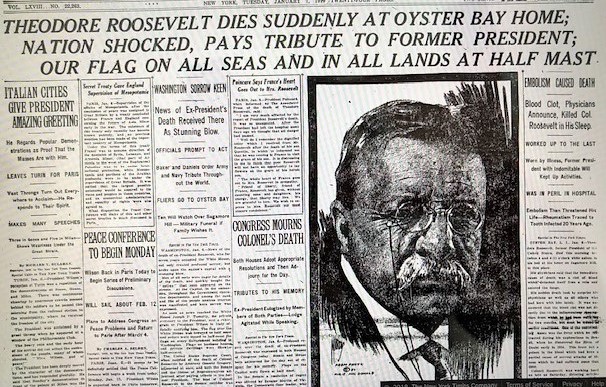
Front page of the New York Times, January 7, 1919

For several decades in American politics, all roads led to Oyster Bay, N.Y.   There stood the home of Theodore Roosevelt, a sprawling wooden house with deep porches named Sagamore Hill.   

He presided over it for 33 years, even while he was off being Civil Service Commissioner, New York City Police Commissioner, Assistant Secretary of the Navy, a Rough Rider, Governor of New York State, Vice President, and – of course –a larger-than-life President. 

Just before he died, he turned to his wife and said, “I wonder if you will ever know how much I love Sagamore Hill.”

Postcard, 1890s

Theodore had purchased the land in 1880, 155 acres overlooking Oyster Bay, the same year he graduated from Harvard and married “my own sweet, pretty darling” on his 22nd birthday.  He intended to build a home for a large family.  

He hired architects to design a 22-room Queen Anne-style house, to be called Leeholm after his doll-like bride, Alice Lee Roosevelt.  But Alice died in childbirth in February 1884, after delivering a daughter whom Theodore named for her mother.  Coincidentally, Theodore’s own mother, Martha, died the same day. 

Alice Hathaway Lee Roosevelt

Grief-stricken, he left the baby in the care of his sister, Bamie, and stormed off to the Dakota Territory believing that happiness had fled his life forever. 

Before the harrowing departure, TR, as he would be known, ordered construction of the house to proceed.  But now it was to be called Sagamore Hill instead of Leeholm. 

During the next year, TR spent most of his time out west at his ranch on the Little Missouri River.  He did not wish to see the beautiful child who reminded him of the wife he had lost. He could not bear to live in the house he had promised Alice Lee.  His political future – he had been a fledgling state assemblyman – was uncertain.  


Theodore Roosevelt, Dakota Territory, mid-1880s

And yet, by late 1885, everything changed.  Incapable of living outside the arena, Theodore had moved back east, taken up residence at Sagamore Hill, and become acquainted with his precocious daughter. 

Perhaps most significantly, he and his childhood sweetheart, Edith Carow, had started to meet in secret and made plans to marry.  This caused TR equal parts of exhilaration and agony.  Notwithstanding his generally progressive outlook, he was a Victorian at heart.  In the pages of his diary, he accused himself of inconstancy. 

But he and Edith were passionately in love.  “You know all about me darling,” Edith told Theodore.  “I never could have loved anyone else.”


Edith Carow, newly engaged to TR, exuded
confidence even while dressed in an unflattering hat.

They married in London in 1886.  When they returned from Europe, Edith insisted that little Alice join their family.   Five more children would follow.  They all grew up together at Sagamore Hill, when they weren’t living in Albany or Washington, D.C.

Wherever “Father” went, excitement followed: riding horses, hiking, swimming, tennis; entertaining visitors, debating, reading aloud, and mischief.   It was always “Edie,” however, at the center of his life.

The Roosevelt family, without Alice, around 1900

Many years later Alice Roosevelt reported that Edith, who could be very catty, once told her that TR would have been bored to death if his first wife, Alice, had lived.

Most likely Edith spoke the truth.  After all, she had proof.    

While Edith destroyed every love letter that passed between herself and Theodore, evidently there was one that she could not bear to burn.  It emerged from hiding during the late 1970s when the writer Sylvia Jukes Morris was researching the first scholarly biography of Edith Roosevelt.  Theodore had sent it to his wife in 1914. 

The story goes that TR, deeply disappointed by his failed Bull Moose bid for the presidency in 1912, asked his son, Kermit, to join him on an ill-considered expedition down the 950-mile River of Doubt in Brazil.  They embarked on the disastrous trip in 1913.  Battling malaria, dysentery and infection in the Amazon wilderness, Theodore at one point begged to be left behind to drink the poisonous contents of a vial he had brought along.

He wrote to Edith:

Oh, sweetest of all sweet girls, last night I dreamt that I was with you, and that our separation was but a dream; and when I waked up it was almost too hard to bear.  Well, one must pay for everything; you have made the real happiness of my life; and so it is natural and right that I should [be] constantly more and more lonely without you . . .  Darling, I love you so. . . .  How very happy we have been for these 23 years!

TR did not drink the poison, but he returned to the U.S. with his body wrecked.  While he continued his interest in politics and wrote prolifically, his life quieted.  And then, in July 1918, the Roosevelts’ youngest son, Quentin, was killed in aerial combat over France.

“How am I going to break it to Mrs. Roosevelt?” TR asked the reporter who had brought the news to Sagamore Hill. 


Less than six months later, “the old lion,” as one of his sons described him, died at the age of 60.  Now nearly 100 years have passed, and the anniversary of TR’s death falls on January 6, 2019.   It will be interesting to see how the centennial is recognized.

He lived a life of intellect, sorrow, and error . . . inquiry, imagination, and more.  There is much to admire and much to criticize.  Today, some historians believe that he showed symptoms of hypomania, which explains his restlessness, recklessness, and productiveness.  

Having studied him informally for many years, I find his intense love of people and places more and more compelling.  Time and again, those deep attachments helped Theodore Roosevelt to right his own world.  Unironically they failed him -- one of the great warmongers of his age -- only with the senseless loss of his beloved son.


A Librarian's Journey - Part 2

New York State Library Reading Room ( New York State Library School Circular of Information , 1909-1910)   When he arrived in 1919 at the Ne...